
Automated Dispensing Robot Videos

A World of Robotic Dispensing and Assembly Solutions

Top Stainless Steel Door Plate Suppliers in China?

Choosing a reliable Stainless Steel Door Plate supplier in China requires more than comparing prices or browsing polished product photos. Door plates may look simple, yet small differences in steel grade, thickness, edge finishing, and hole placement can affect installation and service life. A plate fitted to a busy hotel corridor faces different wear than one used on a private office door. Details matter.

This guide introduces suppliers and explains what buyers should verify before requesting a quotation. Useful checks include available material specifications, dimensional tolerances, finish samples, customization options, and documented quality-control steps. Ask how suppliers inspect scratches, burrs, and inconsistent polishing. Request a physical sample when the appearance or fit is important. A catalogue is not proof. Production capacity, lead times, packaging, and communication also deserve attention, especially for repeat orders. Supplier claims should be checked against clear documents and direct questions, not accepted at face value.

No single company is the right choice for every project. A large manufacturer may offer broad production resources, while a smaller workshop may respond more flexibly to custom dimensions. Both can have limitations. Public information rarely reveals every detail about a factory’s day-to-day consistency, and even a good sample cannot guarantee every batch will match perfectly. Buyers should compare practical evidence, clarify requirements in writing, and assess how a supplier handles questions and corrections. The profiles that follow are a starting point, not a substitute for due diligence.
Top Stainless Steel Door Plate Suppliers in China?

Stainless Steel Door Plate Grades: 304’s 18/8 Composition and 316’s Molybdenum

Stainless steel door plates are often specified by grade, but the numbers describe more than a sales label. Grade 304 is commonly called 18/8 because it contains about 18% chromium and 8% nickel. These elements support corrosion resistance and help the steel retain a clean appearance. That matters. A brushed plate beside a busy entrance may collect fingerprints, grit, and cleaning residue. Its finish affects upkeep, but it does not confirm its grade. Ask suppliers for material documentation, not just a polished sample.

Grade 316 also contains chromium and nickel, with molybdenum added to improve resistance to pitting and crevice corrosion. This can be useful near coastlines, swimming pools, or entrances exposed to de-icing salts. It is not corrosion-proof. Poor cleaning, trapped moisture, or unsuitable fabrication can still leave marks. Not a guarantee. The real environment matters more than a broad claim that one grade is always better.

When comparing suppliers in China, request the stated grade, thickness tolerance, finish description, and a material test certificate for the quoted batch. A handheld positive material identification check may help verify alloy composition, though it should not replace proper documentation. A practical selection rule is to match the grade to exposure, then check fabrication quality. I would not choose by shine alone; that shortcut is tempting, and sometimes wrong.

How Chinese Suppliers Form Door Plates: Sheet Thickness, Cutting, and Finishing

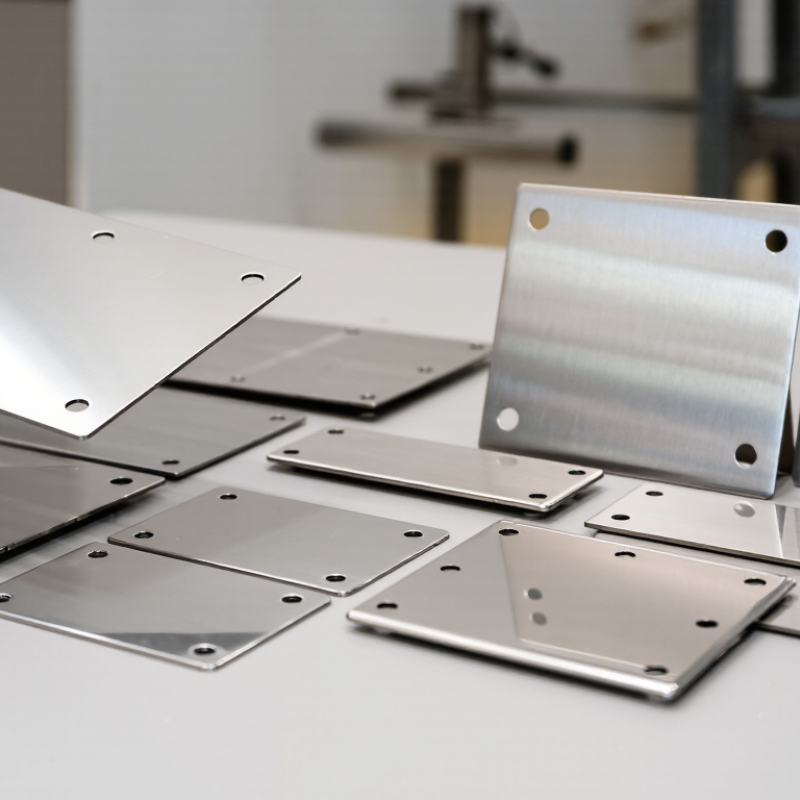
Chinese suppliers usually begin with stainless sheet or coil, then cut blanks by laser, turret punching, or shearing. The right route depends on plate shape, hole count, edge quality, and order volume. Specify finished thickness, not just the nominal sheet gauge; ask how the supplier checks thickness across the sheet. A micrometer reading at one corner can miss variation elsewhere. Small details matter. For a door plate exposed to frequent handling, request a sample with the actual mounting holes and rounded edges. Thin stock may look neat but can flex around screws; thicker stock adds weight and cost.

After cutting, workers deburr edges, form bends if required, and apply the specified finish. Brushed grain should run consistently across visible faces, while protective film helps reduce scratches during handling. Ask for photos under angled light, since swirl marks can disappear in straight-on images. The World Stainless Association reported 58.4 million tonnes of stainless crude steel production in 2023 in Stainless Steel in Figures 2024. That scale signals a mature material supply chain, but it does not guarantee uniform door-plate quality. Request material grade documentation, thickness records, and a first-piece inspection before batch production. I would still inspect the delivered parts: finishing consistency is easy to underestimate.

Common Stainless Steel Door Plate Thicknesses

These are common nominal thickness options for stainless steel door plates, not supplier averages or a universal specification. The appropriate thickness depends on the plate’s size, fixing method, and intended use. Cutting and finishing requirements should be confirmed separately.

Supplier Quality Checks: ASTM A240 Material Specs and ISO 9227 Salt-Spray Tests

Top Stainless Steel Door Plate Suppliers in China?

A reliable door-plate supplier should provide traceable mill test reports, not just a polished sample. ASTM A240/A240M covers stainless steel plate, sheet, and strip, including common grades such as 304 and 316. Check that the reported chemistry matches the ordered grade and the heat number marked on the material. For example, grade 304 typically contains 18–20% chromium and 8–10.5% nickel. Small details matter.

ISO 9227 defines salt-spray test methods, including neutral salt spray. Ask for the test method, exposure duration, specimen preparation, and the acceptance criteria agreed for your product. A salt-spray result is useful for comparing samples under controlled conditions, but it does not predict years of outdoor service. Test hours are not a universal durability rating. Door edges, drilled holes, and cut surfaces deserve attention; they may corrode sooner than a flat, polished face.

The NACE International IMPACT study estimated global corrosion costs at US$2.5 trillion, or 3.4% of global GDP, based on 2013 data. That figure covers many industries, not door plates alone, but it shows why verification matters. Compare supplier certificates with independent test results when the application is exposed to moisture or de-icing salts. One caveat: paperwork can look complete while sample identification remains unclear. Tie each report to the actual production batch.

Top Stainless Steel Door Plate Suppliers in China? - Supplier Quality Checks: ASTM A240 Material Specs and ISO 9227 Salt-Spray Tests

Quality Dimension Applicable Reference or Basis What to Request from a Supplier Verification Method Acceptance Basis
Stainless steel grade and product form ASTM A240/A240M covers chromium and chromium-nickel stainless steel plate, sheet, and strip for pressure vessels and general applications. Mill test certificate identifying the grade, product form, heat or lot number, and applicable standard edition. Match the certificate and material identification to the delivered plate or sheet; independently test chemistry when required by the purchase specification. The ordered grade and product form must match the approved drawing and purchase order. ASTM A240 grade requirements depend on the specified grade and edition.
Material traceability Purchase-order and quality-plan requirements; certificate traceability to the relevant material heat or lot. Traceability records linking the material certificate, production batch, inspection report, and packed goods. Check heat or lot identifiers on records and, where applicable, on material labels or packaging. Identifiers must form a consistent, documented link from incoming material to the supplied door plates.
Chemical composition The specified ASTM A240/A240M grade and its applicable edition. Heat-analysis results and confirmation that the reported elements meet the limits for the ordered grade. Review the mill test certificate; use an agreed independent laboratory or material analyzer if verification is required. Compare results with the exact grade requirements in the purchase specification and applicable standard edition; do not use a generic stainless-steel composition as the limit.
Mechanical properties The specified ASTM A240/A240M grade, product form, thickness, and applicable edition. Reported mechanical-test results where required by the grade specification or purchase order. Review certificate results and confirm that the test basis applies to the ordered product. Use the requirements for the exact grade and product form; do not apply one set of mechanical limits to every stainless-steel grade.
Thickness and dimensions Approved drawing, purchase order, and agreed dimensional tolerances. Inspection report recording plate thickness, length, width, hole positions, and other specified features. Measure samples with suitable calibrated equipment and compare them with the approved drawing. Meet the drawing and purchase-order tolerances. ASTM A240 material compliance alone does not establish all finished-door-plate dimensions.
Surface finish and visible defects Approved sample, drawing, and purchase specification. Defined finish description and inspection records for scratches, dents, burrs, discoloration, and edge condition. Visual inspection under agreed lighting and comparison with the approved finish sample or specification. Meet the agreed appearance criteria; record any limits for repair, rejection, or cosmetic variation before production.
Salt-spray test method ISO 9227 specifies salt-spray corrosion-test methods, including neutral salt spray (NSS), acetic acid salt spray (AASS), and copper-accelerated acetic acid salt spray (CASS). Test report naming the method used, specimen preparation, exposure duration, and any deviations. Confirm that the method is appropriate to the coating or finished assembly being evaluated and that the report identifies the test conditions. Specify the required ISO 9227 method and duration in the purchase or test plan. ISO 9227 describes test procedures; it does not set a universal pass/fail duration for door plates.
NSS test conditions ISO 9227 neutral salt spray method: a sodium chloride solution of 50 ± 5 g/L, chamber temperature of 35 ± 2 °C, and collected-solution pH of 6.5–7.2. Laboratory records for solution concentration, chamber temperature, pH, and exposure time. Review the report for recorded conditions and confirm the test is identified as NSS under the applicable ISO 9227 edition. Conditions must follow the applicable edition of ISO 9227 and the agreed test plan. These conditions describe the method, not a product acceptance limit.
Salt-spray acceptance criteria Customer specification, coating specification, or approved product test plan used alongside ISO 9227. Written criteria defining permitted corrosion, blistering, staining, or other relevant changes, plus the required exposure duration. Evaluate the tested specimen against the pre-agreed criteria and retain photographs and the laboratory report. Set criteria before testing. Salt-spray hours should not be treated as a direct prediction of service life in a particular environment.
Inspection and test equipment Supplier quality plan and the measurement or test methods specified for the order. Inspection records identifying equipment and, where applicable, calibration status. Check that measuring equipment is suitable for the characteristic being inspected and that required calibration records are available. Inspection results should be reproducible and supported by records appropriate to the purchase requirements.
Nonconformance control Purchase agreement and the supplier’s documented quality process. Written process for identifying, segregating, reporting, and resolving nonconforming material or finished plates. Review a sample nonconformance record or corrective-action report, with confidential details removed if needed. Require documented customer notification and approval before using or substituting material that does not meet the agreed specification.

Evaluation note: This is a supplier-quality checklist, not a verified ranking of individual suppliers. Confirm the applicable editions of ASTM A240/A240M and ISO 9227, together with the exact grade, product requirements, and acceptance criteria, in the purchase specification.

How to Compare Chinese Suppliers: Certifications, Capacity, Samples, and Lead Times

When comparing Chinese stainless steel door plate suppliers, verify certificates rather than relying on logos in a brochure. Check the certificate holder, validity dates, and whether its scope covers the actual manufacturing site. ISO 9001 can indicate a documented quality system, but it does not prove every plate meets your drawing. Details matter.

Capacity needs evidence. The World Stainless report Stainless Steel in Figures 2024 recorded 58.4 million tonnes of global stainless steel production in 2023, up 4.6% from 2022. This is useful market context, not proof of any supplier’s output. Ask for monthly production records, available press or cutting capacity, and current order commitments. A busy factory may still meet your schedule—or may not.

Request samples made to your specified grade, thickness, finish, and edge treatment. Inspect them under consistent lighting for scratches, burrs, flatness, and protective-film adhesion. Compare samples with the production approval process, not just a polished showroom piece. That gap matters. Ask suppliers to separate tooling, production, inspection, and shipping time in their lead-time quotes. Then request recent on-time delivery figures and clarify what happens if raw material or artwork approval is delayed. I would treat an unusually short promise as a question, not an advantage.

How to Specify a Door Plate Quote: Grade, Dimensions, Finish, and Tolerances

For a door plate quote, specify the stainless grade, thickness, finished dimensions, surface finish, and tolerances. Grade 304 suits many indoor applications; grade 316 is often preferred where salt or cleaning chemicals increase corrosion risk. State whether dimensions are nominal or finished sizes, and identify the measurement units. A plate that looks correct on a drawing may still bind against a door edge.

Ask suppliers to quote thickness and dimensional tolerances explicitly, rather than writing “standard tolerance.” ASTM A480/A480M provides general requirements for stainless flat-rolled products, but it does not replace application-specific requirements. The World Stainless Association reported global stainless-steel melt-shop production of 58.4 million tonnes in 2023. That scale indicates a broad material supply, not consistent quality between mills or fabricators. Request a sample, finish reference, and inspection method before approving production. Small details matter.

Tips: Send a dimensioned drawing and name the visible face. Specify brushed direction, corner radius, hole positions, and acceptable scratches. For a brushed finish, define the grain direction; “satin” alone can mean different things. Keep one tolerance table for every supplier. Quotes are easier to compare that way, though even a careful specification can miss a detail.