
Automated Dispensing Robot Videos
A World of Robotic Dispensing and Assembly SolutionsTop Ebike Cable Manufacturers for Global Buyers
The global e-bike market is expanding, but cable quality remains an overlooked buying decision. Reports from the International Energy Agency and Grand View Research show sustained growth in electric two-wheelers and supporting components. Their findings point to rising demand for safer, longer-lasting mobility systems. That demand reaches every connector, harness, and brake cable.
This guide examines top Ebike Cable manufacturers for global buyers. It focuses on measurable performance, not attractive catalog images. Buyers should review conductor materials, insulation thickness, bending endurance, waterproofing, connector fit, and production traceability. A cable running beside a rear wheel faces vibration, rain, mud, and repeated steering movement. Small weaknesses can become expensive warranty claims.
Supplier evaluation also requires evidence. ISO 9001 systems, batch records, sample testing, and clear compliance documentation can reveal manufacturing discipline. Depending on the destination market, buyers may also request RoHS, REACH, or relevant electrical safety documentation. These requirements do not replace independent testing.
Figures vary.
Market reports often use different definitions of “e-bike,” so forecasts should be compared carefully. No ranking is perfect. A manufacturer with competitive pricing may still lack reliable flex-cycle data or stable connector sourcing. That distinction is easy to miss. By combining industry research with factory audits, prototype testing, and field experience, global buyers can build a more dependable shortlist. The goal is practical: consistent signal transmission, secure power delivery, and cables that remain reliable after thousands of rides.
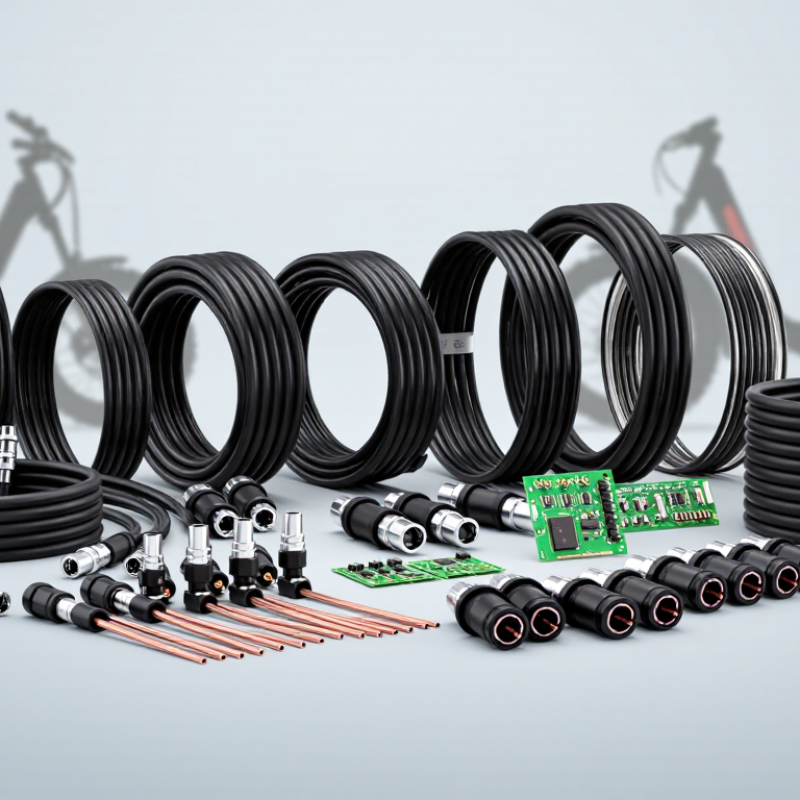
Ebike Cable Basics and Their Role in Electric Bicycle Systems
Ebike cables connect the battery, controller, display, motor, sensors, and lighting circuits. They carry power or transmit control signals across the bicycle. A cable may look simple, but its conductor size, insulation, connector design, and sealing determine system reliability. In workshop inspections, loose terminals often cause intermittent power loss, especially near the handlebar or folding joints. Water can enter through poorly protected connectors. That damage may remain hidden for weeks.
For global buyers, cable selection should match voltage, current, temperature, bending frequency, and installation space. Power cables need suitable copper conductors and heat-resistant insulation. Signal cables require stable shielding and accurate pin arrangements. Connectors should resist vibration, dust, and moisture without becoming difficult to service. Cable length also matters. Excess cable can rub against the frame, while short cable runs create tension during steering. A common mistake is treating every cable as interchangeable. They are not.
Tips: Ask for conductor specifications, insulation ratings, connector drawings, and test records before purchasing. Check bend performance, pull strength, water resistance, and continuity during incoming inspection. Mark each cable clearly during assembly. It saves time later. Do not rely only on appearance. Even a clean connector can contain a weak crimp or a misplaced terminal. Some inspection routines are still too basic, and that weakness deserves regular review.
Top Ebike Cable Manufacturers for Global Buyers - Ebike Cable Basics and Their Role in Electric Bicycle Systems
| Cable Category | Primary System Role | Typical Conductors | Common Conductor Material | Typical Voltage or Signal Use | Common Connector Characteristics | Key Selection Requirements |
|---|---|---|---|---|---|---|
| Battery-to-Controller Cable | Transfers electrical power from the battery pack to the motor controller. | Usually 2 power conductors | Stranded copper, often with flexible PVC or thermoplastic insulation | Battery DC power Common e-bike systems operate at 24 V, 36 V, 48 V, or 52 V nominally. | Polarized, keyed, and touch-safe power connectors; locking features are preferred. | Current capacity, conductor cross-sectional area, insulation temperature rating, polarity protection, and secure strain relief. |
| Motor Phase Cable | Connects the controller’s three-phase output to a brushless hub or mid-drive motor. | Usually 3 larger conductors | Stranded copper with abrasion-resistant insulation | Three-phase motor power Carries higher current than most sensor circuits. | Three high-current contacts or an integrated motor harness; connector sealing is useful in exposed locations. | Continuous and peak current capacity, heat resistance, bend radius, waterproofing, vibration resistance, and phase identification. |
| Hall Sensor Cable | Reports rotor position to the controller for commutation and motor control. | Commonly 5 conductors | Fine-stranded copper | Low-voltage signals Typically includes Hall supply, ground, and three position-signal lines. | Small multi-pin plug, often keyed to prevent incorrect insertion. | Correct pinout, low electrical noise, reliable crimping, insulation quality, and protection from moisture and cable movement. |
| Display or HMI Cable | Links the handlebar display or human-machine interface with the controller. | Commonly 4 to 6 conductors | Stranded copper with flexible outer jacket | Power and communication May carry supply, ground, control, and serial communication signals. | Compact keyed waterproof connector; molded cable assemblies are common for handlebar installation. | Protocol compatibility, connector pinout, bend flexibility, UV resistance, sealing, and resistance to handlebar steering cycles. |
| Throttle Cable | Transmits rider demand from a thumb or twist throttle to the controller. | Usually 3 conductors | Stranded copper | Low-voltage analog signal Typically includes supply, ground, and a variable signal output. | Small three-pin keyed connector; a sealed design is recommended for outdoor use. | Correct signal range, stable shielding or routing, smooth handlebar movement, waterproofing, and compatibility with the controller input. |
| Brake Cut-Off Cable | Signals the controller to reduce or stop motor assistance when a brake lever is activated. | Usually 2 conductors per switch | Stranded copper | On/off safety signal | Small two-pin connector or an integrated brake-sensor lead. | Fast and dependable switching, correct normally-open or normally-closed behavior, mechanical protection, and reliable connector retention. |
| Pedal-Assist Sensor Cable | Connects the cadence sensor to the controller to detect pedal rotation. | Commonly 3 conductors | Fine-stranded copper | Low-voltage pulse signal Usually carries supply, ground, and a pulse output. | Small keyed three-pin connector, normally routed near the bottom bracket. | Correct sensor orientation, pulse compatibility, abrasion resistance, water protection, and adequate cable length for frame routing. |
| Lighting Cable | Supplies front and rear lights from the battery system or controller. | Usually 2 conductors per lighting circuit | Stranded copper | Low-voltage DC power Output voltage depends on the controller or lighting system design. | Compact two-pin connectors or soldered and sealed terminations. | Correct output voltage, total lamp current, polarity, outdoor sealing, UV resistance, and routing away from moving parts. |
| Charging Cable | Connects the charger to the battery’s charging port. | Usually 2 power conductors | Stranded copper with insulated or molded construction | Charging DC power Must match the battery pack and charger specifications. | Polarized charging connector with a secure fit; port design varies by system. | Charging current, voltage compatibility, polarity, contact temperature, insulation, strain relief, and protection against accidental short circuits. |
| Frame Main Harness | Combines multiple power, sensor, control, and communication circuits inside or along the bicycle frame. | Multi-core; varies by system architecture | Stranded copper with a consolidated outer jacket or protective sleeve | Mixed power and signal circuits | Multi-branch harness with keyed, sealed, and locking connectors. | Branch identification, connector compatibility, bend radius, abrasion protection, water ingress resistance, serviceability, and EMC-aware routing. |
| Cable Protection Sleeve | Protects electrical wires from abrasion, heat, dirt, and repeated frame movement. | Not an electrical conductor | Braided PET, nylon, spiral wrap, textile braid, or corrugated polymer | Mechanical protection | May be combined with heat-shrink tubing, clips, grommets, or frame cable guides. | Wear resistance, flexibility, temperature range, flame behavior, installation method, and compatibility with the bicycle frame finish. |
Note: Cable construction, connector pinout, current rating, and communication protocol vary by e-bike system. Always verify the original equipment specifications before selecting a replacement or custom cable assembly.