
Automated Dispensing Robot Videos

A World of Robotic Dispensing and Assembly Solutions

What Are Geosynthetic Materials and Their Main Types?

Geo Synthetic Materials are engineered polymers used to improve soil, water control, and structural performance. They appear beneath highways, around landfills, and beside drainage channels. Common types include geotextiles, geomembranes, geogrids, geocomposites, and geosynthetic clay liners. Each type performs a different function. Separation prevents soil mixing. Reinforcement distributes loads. Filtration allows water through while retaining particles.

The market is expanding, but the numbers require careful reading. Grand View Research estimated the global geosynthetics market at approximately USD 14.1 billion in 2023. Its report projects continued growth through 2030, driven by transport infrastructure, mining, and environmental protection. MarketsandMarkets has also identified infrastructure development and landfill applications as major demand areas. These figures describe commercial value, not guaranteed project success. Site conditions still decide performance.

Dr. Robert M. Koerner, a leading geosynthetics educator and founder of the Geosynthetic Institute, wrote, “Geosynthetics are synthetic materials used in geotechnical engineering.” That definition is simple, but not complete. Design quality depends on polymer selection, installation practices, drainage behavior, temperature, ultraviolet exposure, and long-term loading. A geomembrane may look flawless beside a containment pond, yet one poorly welded seam can undermine the entire system. This guide examines the main Geo Synthetic Materials, their practical roles, and the evidence behind their use. It also questions common assumptions. More material does not always mean better engineering. Performance must be measured against the site, the soil, and the intended service life.
What Are Geosynthetic Materials and Their Main Types?

What Are Geosynthetic Materials and How Do They Work?

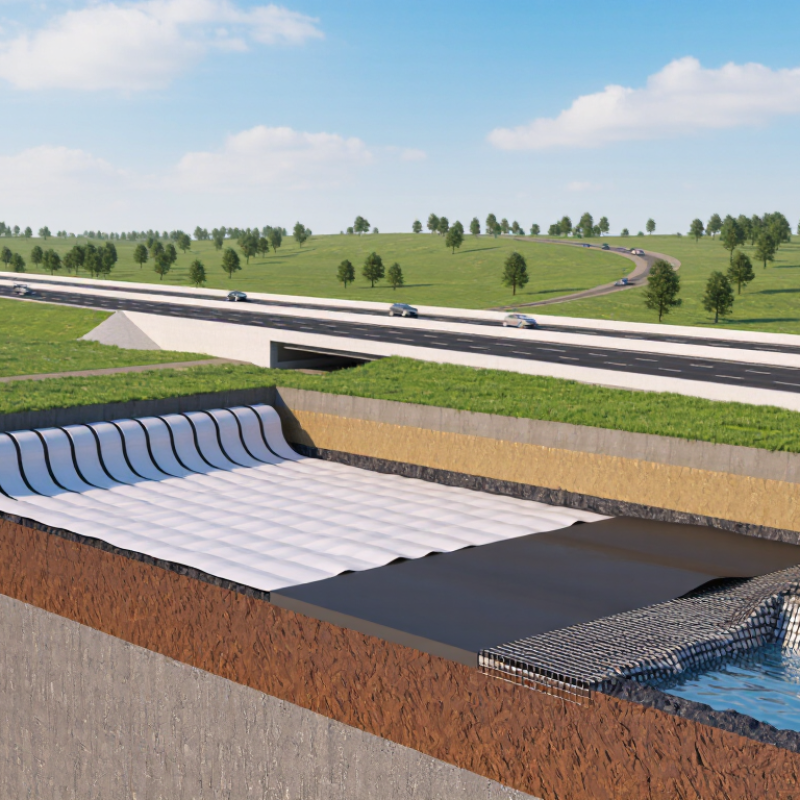
Geosynthetic materials are engineered products placed in soil or alongside it to improve ground performance. They are made from polymers, clay, or polymer-clay combinations. Their action depends on structure, loading, drainage, and installation quality. A geotextile may separate weak clay from crushed stone beneath a road. Its pores let water pass while holding soil particles apart. This reduces pumping, rutting, and the gradual mixing of layers. On real sites, a small overlap error can weaken an otherwise sound design.

Geogrids work differently. Their open, ribbed structure grips aggregate and spreads wheel loads across a wider area. This confinement can reduce deformation over soft subgrades. Geomembranes form low-permeability barriers around ponds, tunnels, and containment systems. They control liquid or vapor movement, but punctures, wrinkles, and poor seams can defeat that purpose. Geosynthetic clay liners add bentonite between carrier layers. When hydrated, the clay swells and creates a tight mineral barrier. Moisture conditions matter greatly.

Geocomposites combine functions, such as drainage and filtration, in one manufactured layer. A drainage core can carry water toward an outlet while protective fabrics prevent clogging. Geocells confine fill within three-dimensional pockets, helping stabilize slopes, channels, and access roads. Engineers select types after checking soil strength, water flow, chemical exposure, temperature, and expected loads. Installation deserves equal attention. Folded sheets, trapped stones, and untested seams create hidden risks. I have found that drawings often look precise, while field conditions remain stubbornly irregular. That gap requires inspection, testing, and sometimes a cautious redesign.

How Geosynthetic Materials Are Made and Classified

What Are Geosynthetic Materials and Their Main Types?

Geosynthetic materials are manufactured products used to improve soil and water control. They are commonly made from polymer pellets, powders, or fibers. Polyethylene, polypropylene, and polyester are frequent raw materials. During production, heat forms the polymer into sheets, threads, or three-dimensional structures. Needling, weaving, extrusion, and coating create different performance properties. Manufacturing details matter because temperature and fiber arrangement affect strength, drainage, and durability.

Classification usually follows product form and engineering function. Geotextiles separate, filter, reinforce, or protect soil layers. Geomembranes provide a low-permeability barrier for ponds, channels, and containment areas. Geogrids reinforce weak ground beneath roads and embankments. Geonets support drainage, while geocomposites combine several functions. Geosynthetic clay liners include bentonite between supporting fabrics. The categories can overlap. Real projects are rarely perfectly tidy. A reliable specification records polymer type, thickness, mass per area, tensile strength, and permeability. Field testing still matters, because laboratory results cannot represent every installation condition.

Tips: Inspect rolls for tears, moisture, and uneven edges before installation. Keep materials covered but ventilated. Avoid dragging them across sharp aggregate. Confirm seam quality with suitable testing. A small installation mistake can reduce long-term performance.

Geosynthetic materials are polymeric products used in civil engineering to reinforce, separate, filter, drain, protect, or contain soil and water. The chart compares the representative densities of polymers commonly used to manufacture geotextiles, geomembranes, geogrids, geonets, and related products. Density is expressed in grams per cubic centimeter (g/cm³), with values varying slightly by formulation and additives.

What Are the Main Types of Geosynthetic Materials?

Geosynthetic materials are polymer-based products placed in soil, rock, or water systems. They improve separation, filtration, drainage, reinforcement, protection, or containment. The International Geosynthetics Society identifies geotextiles, geogrids, geomembranes, geonets, geosynthetic clay liners, geocells, and geofoams as major families. Their applications are expanding. Grand View Research estimated the global geosynthetics market at about USD 13.9 billion in 2023, with continued growth expected through 2030.

Geotextiles are flexible fabrics used beneath roads, around drainage pipes, or against erosion. Woven types usually provide higher tensile strength, while nonwoven types filter water more effectively. Geogrids have open, rigid structures that reinforce weak soil beneath highways and retaining walls. Geomembranes are very low-permeability sheets for reservoirs, landfills, and wastewater ponds. Geonets create drainage paths, while geosynthetic clay liners combine clay minerals with carrier layers. Geocells form honeycomb pockets that stabilize slopes and unpaved surfaces. Geofoams are lightweight fillers for reducing pressure behind structures.

The categories overlap in practice. A drainage layer may also protect a liner. That detail matters.

Tips: Match the product to the soil, load, water flow, and installation damage risk. Check puncture resistance, seam quality, and long-term exposure data. Field experience shows that poor overlaps can undermine excellent materials. I still review site conditions twice; design tables cannot capture every muddy corner. According to Federal Highway Administration guidance, testing should support assumptions about strength, filtration, drainage, and durability. Specification alone is not enough.

What Are Geosynthetic Materials and Their Main Types?

Geosynthetic Type Common Materials Primary Function Typical Applications Key Properties Important Considerations
Geotextiles Polypropylene, polyester, and occasionally polyethylene Separation, filtration, drainage, reinforcement, and erosion control Roads, railways, drainage systems, retaining structures, embankments, and shoreline protection Flexible, permeable, available as woven or nonwoven sheets, with adjustable strength and apparent opening size Performance depends on polymer type, fabric structure, puncture resistance, clogging potential, and exposure conditions
Geogrids Polypropylene, polyester, or high-density polyethylene Soil reinforcement and load distribution Reinforced soil walls, steep slopes, road bases, working platforms, and foundation improvement Open grid structure, high tensile strength, and mechanical interlock with granular soil Design should consider junction strength, strain compatibility, installation damage, creep, and connection details
Geomembranes High-density polyethylene, linear low-density polyethylene, polyvinyl chloride, and flexible polyolefin Liquid and vapor containment Landfill liners and caps, wastewater ponds, irrigation reservoirs, mining containment, and secondary containment Very low hydraulic conductivity, chemical resistance, and continuous sheet-form barrier performance Weld quality, seam testing, puncture protection, weathering, subgrade preparation, and thermal expansion require careful control
Geonets High-density polyethylene In-plane drainage and transmission of liquids or gases Landfill leachate collection, landfill gas drainage, and drainage layers behind walls Three-dimensional ribbed structure with relatively high transmissivity under load Flow capacity can decrease under compression; they are often combined with geotextiles or geomembranes
Geocomposites Combinations of geotextiles, geonets, geogrids, geomembranes, or drainage cores Combined drainage, filtration, separation, reinforcement, or barrier functions Wall drainage, landfill systems, road drainage, green roofs, and foundation waterproofing Multifunctional, space-efficient, and capable of replacing several conventional layers The interface between components, long-term compressive behavior, and compatibility must be evaluated as a complete system
Geosynthetic Clay Liners Bentonite clay enclosed between geotextile layers Hydraulic sealing and reduction of liquid migration Landfill liners and caps, ponds, canals, secondary containment, and soil remediation sites Low hydraulic conductivity when properly hydrated and relatively easy to install compared with thick compacted clay layers Bentonite can be affected by chemical compatibility, desiccation, hydration conditions, and high-concentration saline liquids
Geocells High-density polyethylene or other durable polymer strips Three-dimensional confinement and stabilization of soil or aggregate Unpaved roads, slope protection, channel lining, load support, and erosion control Honeycomb-like cellular structure that limits lateral movement and improves load distribution Cell depth, aperture size, anchorage, infill type, slope angle, and surface drainage affect performance
Erosion Control Geosynthetics Polypropylene, polyester, natural fibers, or polymer nets Reduce soil loss and support vegetation establishment Slopes, channels, riverbanks, construction sites, and revegetation areas Surface protection, sediment retention, flexibility, and—in some products—biodegradability Selection should match rainfall intensity, flow velocity, slope geometry, vegetation goals, and expected service life
Geopipes High-density polyethylene, polypropylene, polyvinyl chloride, or other polymers Conveyance and collection of liquids or gases Subsurface drainage, leachate collection, landfill gas systems, and irrigation or wastewater infrastructure Lightweight, corrosion-resistant, and available in solid-wall or perforated configurations Hydraulic capacity, pipe stiffness, bedding, joint performance, deformation, and access for maintenance should be considered

Note: Geosynthetic materials are polymeric or mineral-based products used in contact with soil, rock, or other geotechnical materials to improve separation, reinforcement, filtration, drainage, containment, or erosion control. Actual performance depends on product specifications, site conditions, installation quality, and project design requirements.

How Each Geosynthetic Type Supports Engineering Projects

What Are Geosynthetic Materials and Their Main Types?

Geosynthetic materials are polymer-based products placed in soil, rock, or water systems. They improve stability, drainage, separation, filtration, and containment. Their performance depends on soil conditions, installation quality, loading, and long-term exposure. A strong design begins with site investigation, not product selection alone.

Geotextiles separate weak soil from aggregate beneath roads, while allowing water to pass through. They can also filter sediment around drains.

Geogrids reinforce soil by interlocking with gravel, supporting retaining walls, slopes, and pavement layers.

Geomembranes provide low-permeability barriers for ponds, tunnels, landfills, and water channels.

Geonets and drainage composites create controlled flow paths behind walls or beneath liners.

Geocells confine soil in three-dimensional pockets, helping stabilize access roads and erosion-prone slopes.

Each type solves a different engineering problem. They are not interchangeable.

Tips:

Check puncture resistance, tensile strength, permeability, chemical compatibility, and seam quality. Protect materials from sharp stones during installation. A design may look reliable on paper yet perform poorly after careless placement. Drainage assumptions also deserve review, especially where clogging or unexpected groundwater may occur. Small site changes can matter.

How to Choose the Right Geosynthetic Material for an Application

Geosynthetic materials are engineered products used with soil, rock, and water. Common types include geotextiles, geogrids, geomembranes, geocomposites, and geosynthetic clay liners. Each type solves a different problem. A geotextile may separate weak soil from aggregate, while a geogrid improves load distribution beneath a road. Geomembranes provide low-permeability barriers for ponds, landfills, and containment areas.

Choosing the right material starts with the site, not the product name. Check the soil strength, expected loads, drainage needs, temperature, chemicals, and ultraviolet exposure. For filtration, review pore size and water permeability. For reinforcement, compare tensile strength, stiffness, and interaction with surrounding soil. For containment, examine puncture resistance, seam performance, and long-term chemical compatibility. A drainage geocomposite may work well behind a retaining wall, but it can fail if clogged by fine soil.

Installation conditions deserve equal attention. Sharp stones, wrinkles, poor overlaps, and rushed seams can reduce performance. Field inspection experience often shows that workmanship matters as much as laboratory strength. Request independent test data, installation guidance, and project-specific calculations. Do not choose only by thickness or price. A thicker product is not automatically stronger, and a cheaper roll may create expensive repairs. I have seen specifications look complete while ignoring settlement and changing groundwater levels. That gap deserves careful review. When conditions remain uncertain, small trial sections and documented site testing can expose problems before full installation.